
Choose a worked example
3 worked examples · 3 short videos each
Structural / Timber and steel flitch beam
Fontana feature: Goal SeekFind the thinnest
passing steel plate
for a flitch beam.
Build a timber-and-steel beam calc from an original technical note. Then use Goal Seek to find the smallest available plate thickness that passes the deflection check, with the other inputs held fixed.
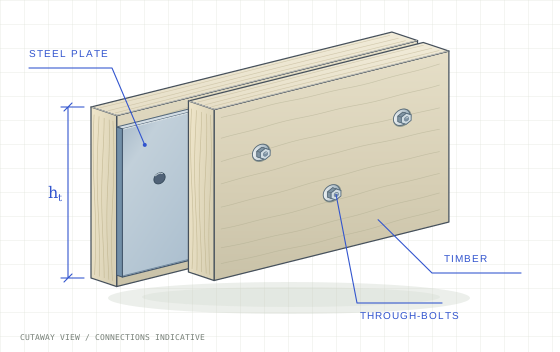
“With the beam depth held at 300 mm, what is the thinnest available steel plate that passes the deflection check?”
01 / Search
Find the geometry
and modelling assumptions.
Ask how the timber members and steel plate share bending. Open the original note to inspect the labelled section, input table and assumed load transfer.
The timber is 300 mm deep; the centred plate is 260 mm deep. Confirm the separate depths and the common-curvature assumption before creating formulas.
The material moduli are stated demo assumptions, with no named timber grade.
Ask about the flitch detail, open the cited note and inspect the original diagram and modelling assumptions.
02 / Custom formulas
Create the stiffness
and deflection formulas.
Use the note to create LaTeX workings for stiffness, bending-moment share, elastic stress and deflection. Keep the source citations with the calculation and use the note’s diagram to review the geometry.
Check the 10 mm plate reference case: 59.13% steel moment share and 13.95 mm bending deflection against the adopted 16 mm demo target.
A deflection pass applies only to the stated model and adopted target.
Create the calculation from the note, review the dimensions and formulas, then compare the reference result with the worked example.
03 / Goal Seek
Find the thinnest plate
that passes the check.
Open Solve for from the target icon in the calc toolbar. Choose steel plate thickness as the changing input, keep only results where the calc’s check passes, and choose the smallest value.
With the 300 mm timber depth, 4.8 m span, load and other inputs fixed, 8 mm is the smallest passing option among 6, 8, 10 and 12 mm. Its bending deflection is about 15.82 mm, below the adopted 16 mm limit; 6 mm exceeds it.
Only plate thickness changes. This calc contains one immediate-deflection check; a pass does not cover the separate design checks listed below.
Choose the input and passing requirement, find the smallest plate option, then review the 8 mm result and apply it to the calc.
Stiffness and deflection formulas with source citations, plus an 8 mm plate selected from the 6, 8, 10 and 12 mm options under the example’s fixed inputs.
Four pages: original geometry, assumed inputs, a common-curvature model, a worked result and six comparison cases. Companion input and reference-output CSVs are included.
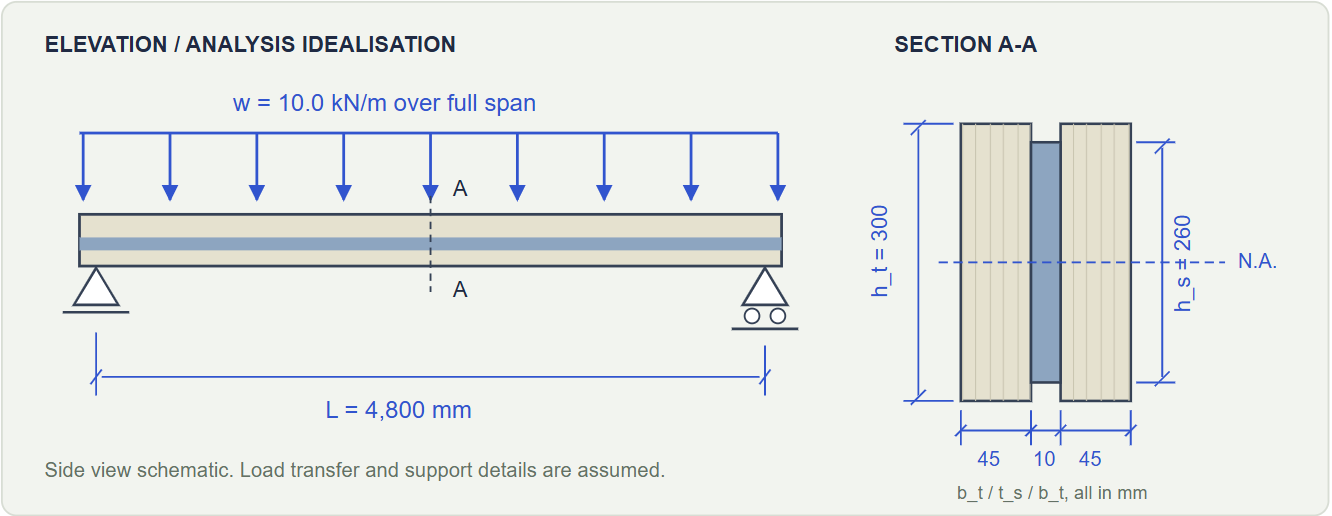
The note analyses an idealised beam with sufficient load transfer to maintain common curvature. Moduli and the deflection target are demonstration assumptions. Results cover elastic bending; connection design, bearing, strength, buckling and total long-term deflection need separate assessment.
More worked examples
Next example:
Concrete corbel
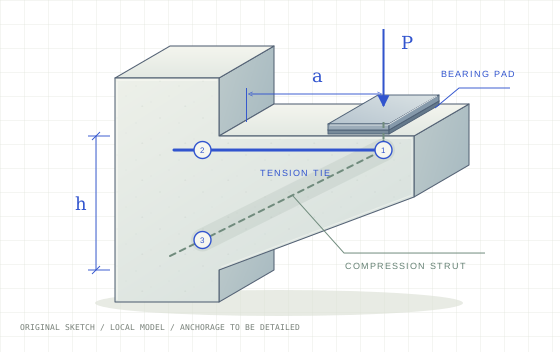 Reinforced concreteConcrete corbelCreate strut-and-tie workings from a labelled corbel sketch.
Demo with your own example
See Fontana with
your own documents.
Bring an engineering document or calculation task.
See how to find source information and build a reusable calculation.